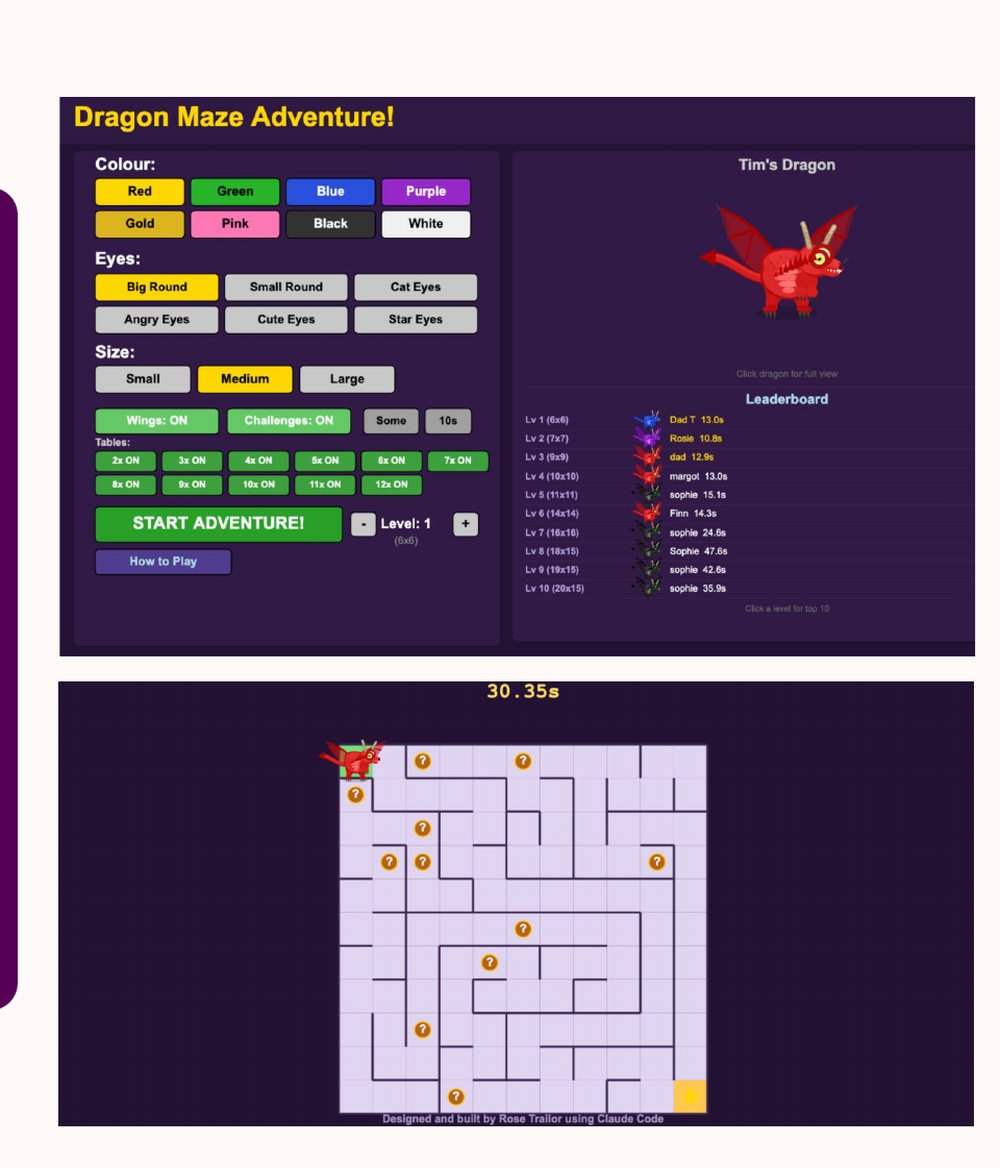
My seven-year-old came to me with a specific idea: design your own dragon, navigate it through a maze, answer multiplication questions to earn time. She knew exactly what she wanted. Choose colour, size, eye shape and whether the dragon had wings. Multiplication hard enough to be interesting but easy enough to beat the timer. Play on the phone or a laptop. Beat her sister’s score.
None of this was on me to design. My job was to sit next to her and type.
You can play Dragon Maze here. Built across 48 hours and a dozen prompt sessions through conversational turns with a coding assistant, most of those turns hers. The credit screen says “Designed and built by Rose Trailor using Claude Code” because that is what happened.
How the sessions went
I sat with her at the laptop. She would say “I want the dragons to have different kinds of eyes” and I would type that into Claude. Claude would propose a way to do it, I would read its proposal back to her in plain English (“it will draw the eyes using curves, so we can change the shape for each kind”), and she would say yes or ask for something different. The code would change, we would refresh the page, she would look at the dragon.
This loop, repeated through the build, is the whole story. The language model translated what she wanted into code; I translated between what the model said and what a seven-year-old would understand; she handled the design.
The one thing we spent disproportionate time on was drawing the dragons. The drawing code is procedural, meaning it draws each dragon mathematically rather than from a pre-drawn picture, so every combination produces something unique. It ended up being hundreds of lines of Bezier curves, and I reran it many more times than was strictly reasonable, because the dragons mattered to her.
What the game can do
Customise a dragon (eight colours, six eye types, three sizes, wings on or off), every combination producing a visually distinct dragon, drawn on the fly.
Play through ten procedurally generated mazes that grow as you progress, each one fresh.
Answer multiplication questions to earn time. Questions are drawn from configurable tables, with the default skewed toward the tables she is learning at school.
Compare scores through a shared leaderboard that runs across devices, so her cousins and classmates can play on their own phones or laptops and the times show up side by side.
Play on a phone. Controls switch to a touch D-pad with swipe support, the layout reflows for a tall screen, and the keyboard for entering a name works properly on iOS.
Why I am writing about it
Partly because it is a lovely thing and she is proud of it.
But also because it shows something about coding assistants that is easy to miss when the conversation is about enterprise workflows. A seven-year-old designed and shipped a game her cousins could play, in 48 hours and a dozen prompt sessions. The game has been played enough times by enough friends and cousins that I can honestly say it’s a bit addictive! Well done Rose (game designer in training).
▸ Play Dragon Maze
Credit goes to Rose. Code is at github.com/timtrailor-hash/dragon-maze. If you are a parent with a kid who has a clear idea, try this with them.